

Your Weekly Insights, Inspirations & Forecast for March July 10 – 16, 2026
Need clarity, vision, and strategy? Benefit from over 30 years of experience to better understand the true ‘you’ beyond outer pressures and layers of social conditioning, what cycles of destiny are underway, and what new chapters are destined to begin now and in the coming months and years.
Contact Michael for an Appointment: sunstarastrology@gmail.com
“It was a pleasure meeting with you. The comfort in sharing my personal life experiences is invaluable. The fact that you could bring me closer to my birth time for a more comprehensible astrological reading is awesome! It is like finding the self I knew was there but couldn’t prove. Add a touch of stardust with a magic wand leading the way in purpose, clarity and confirmation in my healing journey. Blessings to you and yours.” – Janice
See Membership Benefits Here
Insights, Inspirations & Forecast:
The late waning Moon will add to the downward pull of Mercury retrograde in Cancer for the better part of this week. The New Moon occurs on July 14, and it will host Mercury Retrograde, so its influence will have an echoing effect at least for the duration of this lunation cycle, until the next New Moon in Leo on August 12. As well, it can take a day or two to break free from its submersive grip, so while not entirely negative factors, they could feel like they have more of an autumnal feeling than that of the playful summer.
But don’t count summer out yet. In the larger background, Jupiter newly in Leo is advancing to complete a powerful alignment pattern including Uranus, Neptune and Pluto when it achieves 4 Leo, along with these three other far planets also at that degree. The destined peak of this charge will begin on July 19, which happens to be the day of the final match of the FIFA World Cup.
The peak point of this rare alignment can be expected to last for several days, and the follow-up to it is the Sun entering Leo on July 22. It will provide an added boost supporting the energy pattern to also linger, which will prove especially strong through to the Full Moon on July 29. Then it too will continue like aftershocks following a major quake. Hopefully, this will prove figurative and not literal. Also, how any planet alignment manifests is relative to the many fronts of reality, each hosting its own destiny and karma.
All such influences are relative due to their subjective experience. The generic influence is there to be observed, if one has the knowledge to do so, yet how any given ‘person’ (which in the whole sense extends to entire nations, states, provinces, cities, and any other legal entity referred to as a ‘person under the law’) experiences any given ‘influence’ is relative to their overall reality. The word ‘influence’ is highlighted because Astrology is not based on physics and the planets do not influence energetically but rather archetypally, the understanding of which is rare and is too much to explain in the detailed sense at this time.
Suffice to say that planetary positions and alignments ‘reveal’ archetypal principles, which in the deeper sense also indicate that we live in a conscious, intelligent, intentional universe that is founded on metaphysical principles and universal laws that transcend purely materialistic perspectives. Again, this understanding generally requires considerable background knowledge, which the average person has not been exposed to. If you are interested in learning more, begin by studying Holism and its associated root perspective on existence, referred to as Monism, both of which refer to the ultimate oneness of existence, or the protracted subjectivity of it.
The following section will provide an example of this understanding in context to current cycles and further examples associated with human psychology and the human condition.
So, referring to any given planetary position or alignment, otherwise referred to as a ‘generic influence,’ implies that the outer effect(s) are never purely objective. Ironically, or paradoxically, in terms of the ultimate oneness of existence, notions of objectivity in any absolute sense can be correctly categorized as relative illusions. In other words, notions of objectivity can be described as the illusion we share.
This perspective presents a good example of themes associated with Mercury Retrograde in Cancer. Briefly, when Mercury is retrograde, it tends to reverse the logical flow of perception, interpretation, and communication. Interestingly, it does so at quantum levels and beyond, based on the evidence that it is not just the communication between people, but between atoms, as with the breakdown of mechanical processes observed to often occur when Mercury is retrograde.
When in Cancer, which can be correctly understood as the most subjective sign of the entire Zodiac, the sign of roots, ancestry, origins, mothers, and so on, Mercury takes on an even more submersive tendency due to the watery, emotional, subjective characteristic of Cancer.
So, while Mercury is generally associated with the observation of facts, this ability can be deemed warped by the emotional and subjective feelings driving thought processes associated with watery, subjective Cancer.
In the most positive sense, this ‘interference’ with the usual fact-orientation of Mercury produces a more empathetic perspective, otherwise described as emotional intelligence.
For example, imagine a bridge that is crossed daily by thousands. One might assert that there is the bridge as an objective reality, which is true. Yet, the experience of the bridge is invariably subjective. So, the subjective experience of apparently objective reality qualifies as a paradox. This is why different people assert facts with great certainty and conviction, while others offer different facts that even counter or contradict the so-called facts shared. Naturally, the consequences are confusion, frustration, debate, division, conflict and sometimes war.
If we take this understanding to the level of society or politics, or social politics, we are quickly reminded just how much people disagree both about what ‘the facts’ are and, more importantly, what the facts mean, and what their implications suggest. Accordingly, a primary principle of semantics, or the study of linguistic meaning, is that ‘there is no it’.
The principle that there is no “it” in semantics refers to the idea that meaning is not inherent in words or phrases used to describe things and events but is derived from their use in context and the relationships between them. Semantics focuses on how meanings are constructed and understood rather than assuming a fixed reference for terms. This is why the assertion that ‘it is all relative’ is true. There is ever many angles of perspective associated with any aspect of existence or event.
Since facts without meaning can be understood to lack purpose or value, separating them from our experiences, interests, and concerns in life renders them inert, as it were. Since life is all about relationships, which paradoxically includes the relationship we each experience with our own subjectivity, our own body, mind, heart and soul, and experiences divorced from relationships also emerge as inert, we are brought back to our subjectivity.
Not surprisingly, the first principle of Neuroscience is that ‘all perception is subjective’, or it emphasizes that perception depends on neural processes and is influenced by individual awareness and context. Notice how neuroscience evolved out of semantics?
Sharing with others produces bonds of friendship and love, but at the end of the day, we each experience life individually. What this altogether amounts to is the fact that what you or I or anyone else deem to be ‘final facts’ is more fully a matter of opinion, reinforced not only by bias and belief, but by social conditioning.
The main source of this conditioning in our modern technological world is the media. Do you suppose that those who determine what is shared in the media know this? Of course they do. In other words, much of what we assume to think we think independently, are not even our own thoughts, but those ‘conditioned’ by the sources of information to which we each expose ourselves.
It is even true that while most people are able to process information, this is not to say they are able to actually think. Beliefs, assumptions, and information gathered from external sources comprise their notion of knowledge and what is factual and true.
The average person engages in both thinking and sharing learned information, but critical thinking involves actively analyzing and evaluating what one learns rather than simply repeating it. Critical thinking requires questioning assumptions, assessing evidence, and considering multiple perspectives before forming judgments.
What this generally amounts to is that most people are not really aware of what is factual and true, and perhaps not even interested, but rather in what equates to feeling secure. Feeling secure is technically an instinctual response, associated with the fight or flight of survival. In short, public opinion is molded by those invested in the distribution of information for the sake of their own advantage, which generally equates to wealth, power and control of others and situations, which is itself a protracted instinctual response.
A book written as long ago as 1988, with the title “Manufacturing Consent: The Political Economy of the Mass Media” by Edward S. Herman and Noam Chomsky, outlines the evidence that the mainstream media is more fully a vehicle for propaganda than it is for the distribution of genuine facts and information associated with concern for others.
Consequently, people assume great conviction about their views, especially associated with social politics, and are generally not only unwilling, but literally unable to think otherwise, because the thoughts that they assume to be facts were actually placed there strategically. In this regard, our unwitting, or non-critically analyzed exposure to media sources generally includes the presentation of these facts by assumed sincere and honest people.
Referring to such thinking as ‘conspiracy theory’ has been clearly outlined to be itself a ‘planted perception’ to prevent people from thinking critically. The common assumption is that “the news” is the expression of objective, integral journalism. Unfortunately, this is not the case.
Thinking critically begins by asking deeper questions about why one assumes that their notion of fact and truth, and what its source is. Few people will actually do this due in part because the ability to do so is actually a skill that requires sincere effort and determination to develop. In the meantime, we will continue to live in a world governed more by beliefs and assumptions than critically determined facts and truths.
So, what do you think you know and why do you think you assume to know it? Incidentally, this extends to self-awareness as well. So, who and what do you think you are and why do you think you assume to know?
In its deepest reaches, Astrology can profoundly help us know who and what we are beyond casual notions. The ‘what’ question includes that we are souls incarnate. Who we are as embodied souls with ego-personality constructs and what this knowledge implies in terms of how we engage with and co-create our reality is also open for discussion, review, and perhaps, qualitative adjustment based on the deeper levels of awareness towards a deeper feeling that we are indeed living our best life!
While life can seem random and relatively chaotic with multiple unknowns, affirmation that you can intuitively align with and which reveals purpose, timing and possibility, and which guides a sense of self-actualization, can prove grounding and empowering indeed. Learn how an Astrology Reading can help.
Have a great week!
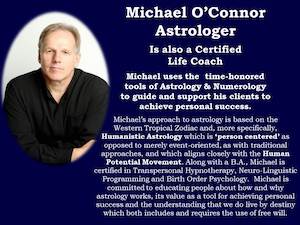
Michael O’Connor
Life Coach Astrologer
Guiding Your Future Probabilities & Possibilities…
www.sunstarastrology.com ~ sunstarastrology@gmail.com
***